
On July 20, I shared a situation at Better Buzz’s new location involving one of their outdoor tables that had graffiti in black permanent marker. I shared how it looked like someone was writing disconnected keywords and symbols associated with crime, terrorism, government agencies, martial arts, and conspiracy-related topics.
The next day, the business removed the table; however, the author must have seen the table was gone and proceeded to write a message on the bathroom wall and mirror.
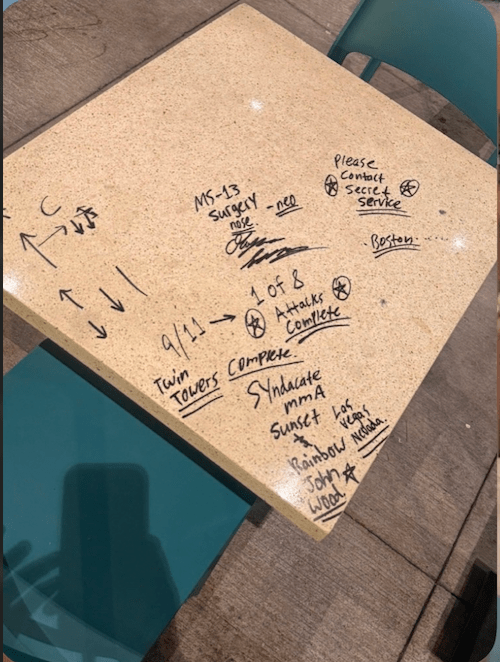
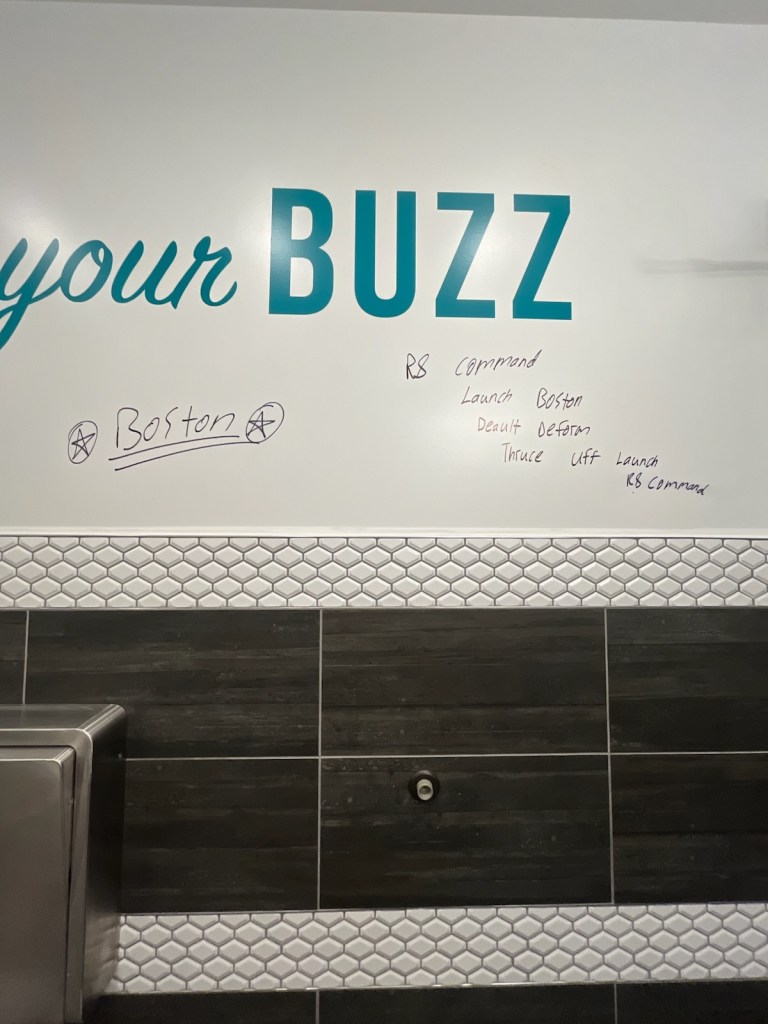
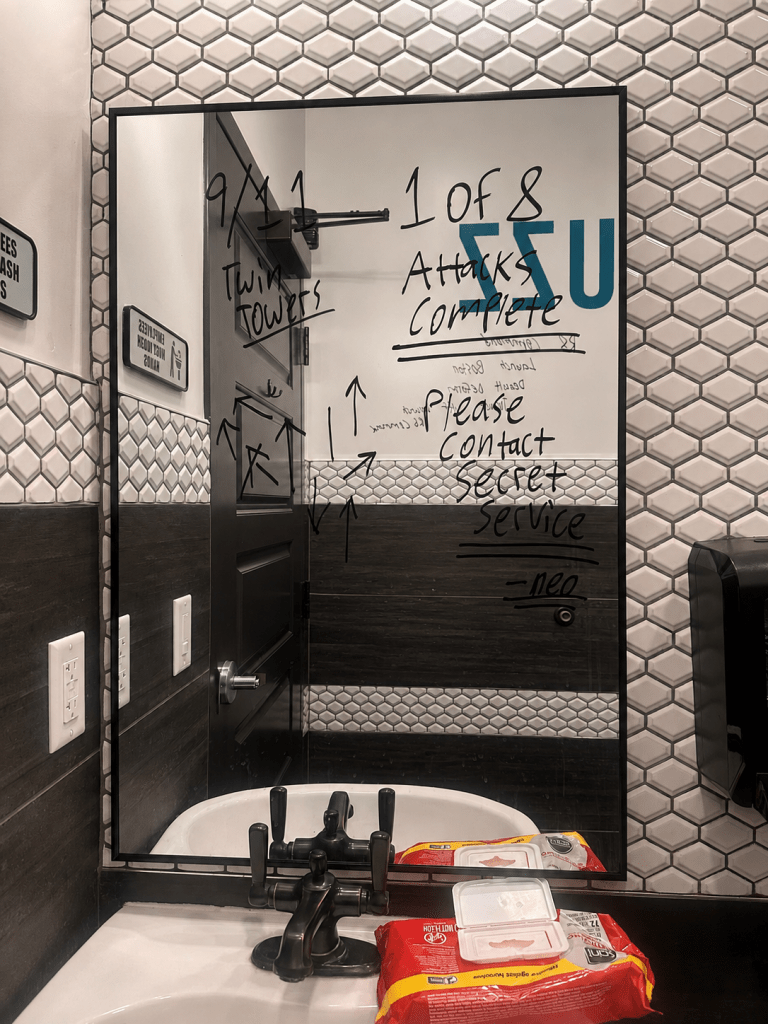
After persistent research and analysis of all three writings, here is the assumption so far:
What initially appeared to be random vandalism—a bizarre collection of references to MS-13, 9/11, the Twin Towers, the Secret Service, Neo, John Wood, Syndicate MMA, and various operational terms—became increasingly difficult to dismiss as incoherent. The author returned the very next day after the original table was removed and reconstructed portions of the diagram elsewhere in the business, suggesting that preserving the information was more important than the physical medium itself.
The most surprising discovery was that the graffiti makes substantially more sense when treated as a conceptual workflow diagram rather than ordinary written language. The author consistently communicates in entities, relationships, commands, workflow states, escalation paths, and completion indicators. Real-world entities such as John Wood and Syndicate MMA (a Las Vegas business), Neo (a Boston-based AI security startup focused on agentic AI), and MS-13 (a transnational criminal organization increasingly associated with cybercrime and federal investigations) all fit neatly into an entity-mapping model. The remaining terms—”1 of 8 Attacks Complete,” “Please Contact Secret Service,” “Launch,” “Command,” “Default,” and various arrows and symbols—more closely resemble status indicators and operational workflow terminology than literal threats or political messaging.
Independent research into modern Agentic AI investigative workflows revealed striking similarities. Today’s law enforcement and intelligence communities are actively exploring AI-driven systems capable of threat assessment, entity resolution, gang network mapping, cybercrime investigations, and human-in-the-loop decision-making. Federal legislation and intelligence community publications further demonstrate growing concerns about the intersection of artificial intelligence, terrorism, and transnational criminal organizations. Conceptually, the graffiti mirrors many of the components found in modern investigative workflows: threat actors, incident classifications, workflow stages, escalation requirements, and entity relationships.
My current working theory is that the graffiti is not a narrative or coded message at all. Rather, it appears to be an externalized conceptual model—an investigative or threat-assessment workflow organized through symbolic abstractions and operational terminology. Whether it was created by a technology professional, a cybersecurity enthusiast, a systems architect, or simply an individual who naturally thinks in systems and relationships remains unknown. What is clear, however, is that the author does not appear to communicate in prose. They communicate in nodes, states, commands, and conceptual relationships. Ironically, the greatest mystery is no longer what the graffiti says, but what internal model the author felt compelled to preserve and communicate—even after it had been erased.
There are a few outstanding elements to conclude.
Meanwhile…
A new video is out: The Sleepless Blogger – An Insomniac’s Tale
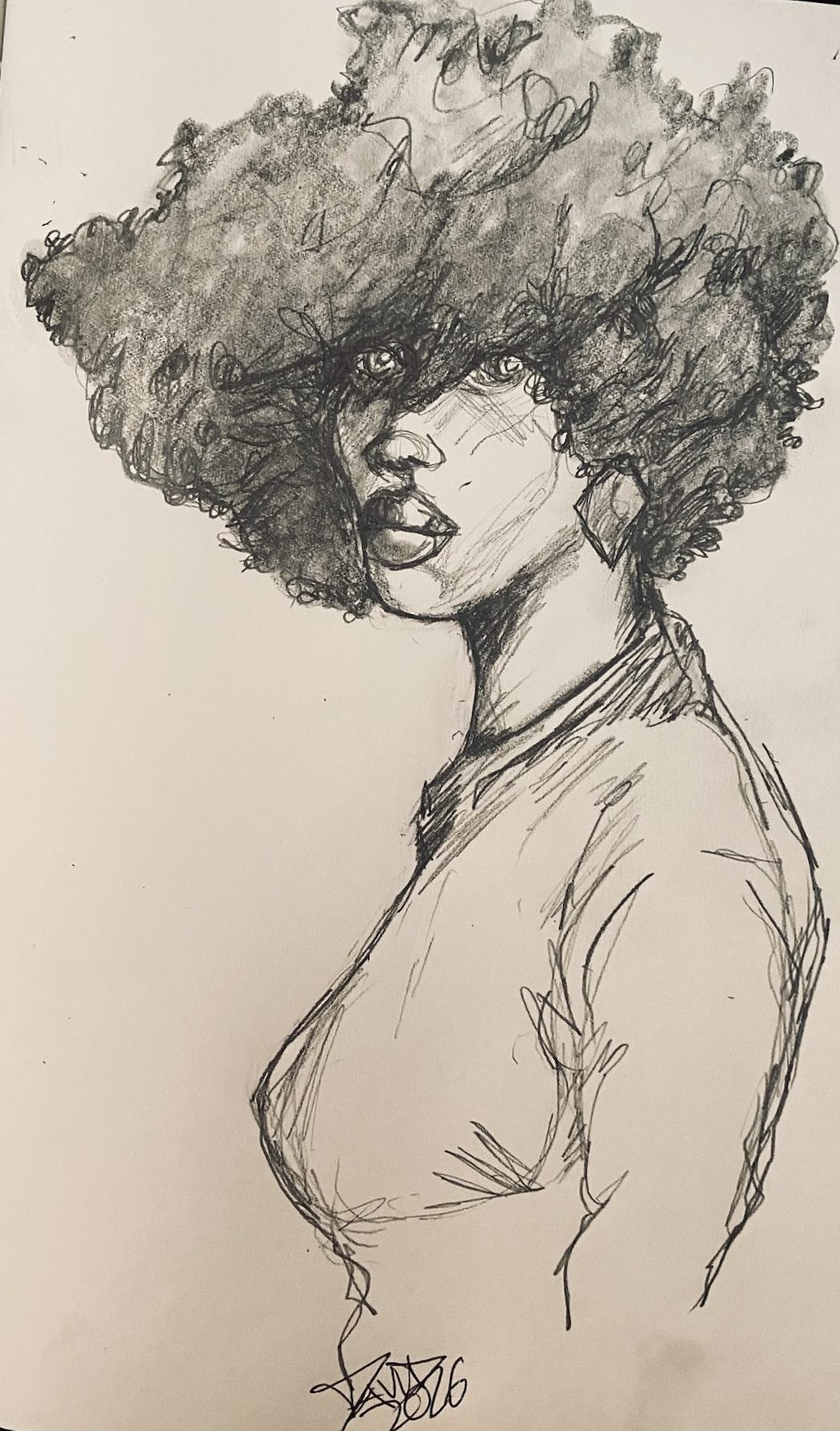
Something from the sketchbook.

Have a great weekend.

 Write Now and Later
You must be logged in to post a comment.